Why Does Bread Dough Collapse After Rising?
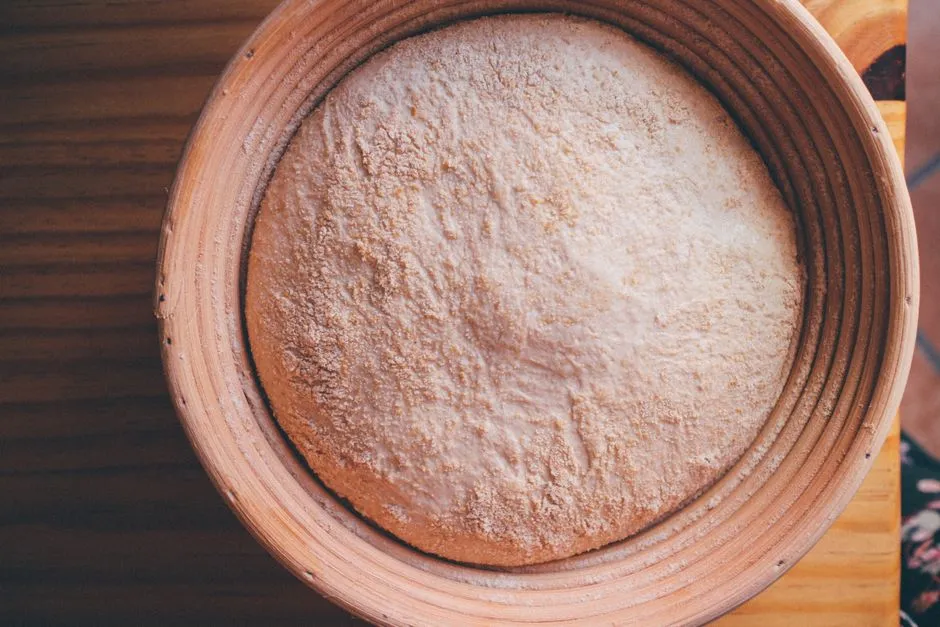
- Why does bread dough collapse after rising?
- What was holding the dough up?
- When did the collapse happen?
- How should you read the rise instead of the clock?
- Can you rescue dough that has already overproofed?
- What should you change on the next bake?
- What belongs in a useful baking note?
- What safety rules still apply?
- Sources
Why does bread dough collapse after rising?
Bread dough can collapse because it has proofed too far, because its flour cannot support the intended structure, or because the oven was not hot enough. Start by recording when it sank, then compare the recipe, flour and rise cues. Some unbaked wheat doughs made with commercial yeast can be reshaped and proofed again; this is not a universal sourdough rescue or a way to make mishandled dough safe.
A loaf that was tall at lunchtime and flat by baking time is disappointing, but the lost height is useful information. This guide concerns wheat bread raised with commercial yeast. Gluten-free bread, high-rye formulas and sourdough need their own recipe-specific troubleshooting.
What was holding the dough up?
Yeast fermentation produces carbon dioxide. In wheat dough, hydrated flour proteins form gluten, and kneading develops a network that retains gas. Expansion needs both gas production and a structure able to hold it, as Red Star's ingredient guide explains.
That distinction matters: adding yeast is not automatically the answer to a loaf that already rose. More fermentation cannot be assumed to repair poor gas retention. For the basic mechanism, start with why bread dough rises.
Overproofing means allowing the rise to go beyond the dough's useful readiness for its next step. In the shaped loaf, excessive expansion can leave the dough fragile. The practical question is not whether it once looked impressive, but whether it still holds the structure the recipe needs.
When did the collapse happen?
Use timing to organise the investigation, not to declare a diagnosis from one photograph.
| What you observed | What to check next | What it does not establish |
|---|---|---|
| Dough expanded, then sagged before baking | Final-proof cues and the interval since shaping | That the yeast was dead from the start |
| Loaf entered the oven tall, then fell | Proofing, recipe's flour and actual oven temperature | That overproofing is the only explanation |
| Bread looked baked but sank later | Baking instructions, doneness checks and cooling directions | That restarting a raw-dough rise will repair it |
| Dough never visibly expanded | A separate investigation of yeast, ingredients and conditions | That a collapse-rescue method applies |
Red Star's troubleshooting guide identifies weak flour, excessive proofing and low oven temperature as possible causes of collapse during baking. It also identifies incomplete baking as a possible reason for a dense, gummy interior.
Do not diagnose underbaking merely from a dark crust, or assume a gummy centre proves excessive proofing. Write down both observations and compare the complete method.
How should you read the rise instead of the clock?
Separate the bulk rise, before dividing or shaping, from the final proof of the shaped bread. A note reading “rose for an hour” is incomplete unless it identifies which stage.
In King Arthur's readiness guidance, the clock is a guide rather than a fixed endpoint. Conditions and dough handling affect the actual rise. A straight-sided container with the starting level marked helps when the recipe asks for doubled volume.
For a shaped pan loaf, use the specified pan and that recipe's height cue. A rule written for one pan is not permission to use any tin and wait for an equally dramatic dome.
The same guidance describes a lightly floured finger test during the second rise: a lasting indentation can signal readiness, while a quick rebound suggests more time. Fragility and collapse during the check suggest the dough has gone too far. An indentation remaining is therefore not, by itself, proof of overproofing.
Use the linked method alongside the recipe's appearance cues. Do not repeatedly press a delicate loaf trying to obtain a more reassuring result.
Can you rescue dough that has already overproofed?
Sometimes, while it is still unbaked. King Arthur's demonstrated rescue covers dough made with active dry yeast or instant yeast not designed for a single quick rise. Its sandwich-loaf approach is:
- Deflate the over-risen dough.
- Reshape it into the loaf form.
- Return it to the recipe's pan.
- Watch the new rise and bake at the appropriate readiness point in the preheated oven.
The source warns that this approach generally does not work for sourdough after its longer fermentation. Do not extend the demonstration to every yeast product, every formula or an already-baked loaf.
Its suggested early recheck is not a guaranteed second timetable. Keep the original recipe available for pan size, shaping, oven setting and baking instructions. This article supplies troubleshooting, not a substitute formula or a claim that we tested your dough.
Reshaping addresses structure, not food safety. Do not use this technique to justify keeping dough with an uncertain handling history.
What should you change on the next bake?
Our editorial approach is to establish a faithful baseline before changing ingredients. Choose one complete recipe and record what you actually used. “White flour” is less informative than the exact flour type and product; “instant yeast” should also identify the product, especially when considering the rescue above.
Check these separately:
- Flour: compare the specified type with the bag used. Red Star recommends using bread flour when the recipe calls for it.
- Oven: fully preheat; use an oven thermometer according to its instructions to check the baking temperature.
- Method: record any changed mixing, shaping, proofing or baking step instead of quietly treating it as part of the original recipe.
If a recipe worked previously, list what differed this time before buying another ingredient. A substitution and a longer proof are two changes, not one. Repeating both while changing the yeast adds a third variable and makes the result harder to interpret.
What belongs in a useful baking note?
Keep a compact record with the recipe version, ingredient identities, pan, bulk-rise endpoint, final-proof observations and oven check. This is our suggested evidence log, not a published experiment:
| Entry | Useful example wording |
|---|---|
| Recipe instruction | Copy the actual rise cue, not merely its estimated time |
| Observation | “Held its shape after shaping; sagged before loading” |
| Change from recipe | “Used a different flour product” |
| Next comparison | “Return to the specified flour; retain the recipe's other steps” |
The entries are prompts, not reports from a real kitchen test. They preserve the difference between what happened and what you think caused it. Bring that record to the recipe publisher's troubleshooting service if repeated attempts fail.
What safety rules still apply?
Raw flour and raw dough must not be tasted, even when no eggs are included. The FDA's flour-safety guidance also directs careful handwashing and cleaning of equipment and surfaces after handling them. Keep raw ingredients away from ready-to-eat food.
Follow the complete recipe and applicable package cooking and storage instructions. Height, smell and a successful new rise do not establish that mishandled dough is safe.
For related explanations, browse fermentation basics and baking science. The next useful loaf begins with a clearer observation, not a longer list of unrecorded adjustments.